災害時の通信
大地震ような大災害の発生時には、どこで何が起きているかを行政が速やかに把握することが重要です。大きな被害を受けた地域から行政へは容易に情報が来ないことが経験的に知られており、大きな地震が発生したときには、県防災ヘリ、政令市消防局や警察のヘリ、自衛隊や海上保安庁のヘリや飛行機などを飛ばして大きな被害を受けた場所を発見しようとします。昼間の晴天時であれば、空からの観測で大きな被災地は把握できますが、荒天であったり夜間であったりすると容易には発見できず、発見は翌朝になってからとか天候が回復してからいうこともあります。災害の発生直後の行政による被災状況の把握において、アマチュア局が活躍できる可能性は高いと思います。
このためには、行政機関(基礎自治体本庁、その出先機関など)にアマチュア局からの情報を受けるためのアマチュア局を配置するとか、災害発生時にアマチュア局からの情報収集を行うことができるアマチュア局に収集した情報を行政機関へ伝達するための手段(防災行政無線の陸上移動局など)を配置する必要があります。
周波数再編アクションプラン(令和6年度版)への意見提出とこの意見に対する総務省の考え方
少し古い話になりますが、以下の意見募集に対して提出した意見は以下のとおりです。
|
周波数再編アクションプラン(令和6年度版)(案)の記載 |
意見 |
||||||||||||||||||||||||||||||||||||
|
アマチュア無線については、ピーク時の1/4に近い数字にまで利用者が減少している状況であり、電波監理審議会による電波の有効利用の程度の評価結果に基づき、ワイヤレス人材育成の裾野を広げるための取組を引き続き進めるとともに、国際的な電波の利用動向、他の新たな電波システムの需要やアマチュア無線の態様等を踏まえた、アマチュア無線全体の周波数割当ての見直しや更なる共用の推進等に向けた検討を行う。 |
貴省が令和4年に開催したワイヤレス人材育成のためのアマチュア無線アドバイザリーボードに提出された資料によれば、人口に対する局数では主要国と比較してはるかに多い(人口1,000人当たりの局数)。
貴省が実施した令和5年度電波の利用状況調査の調査結果によれば、各周波数帯におけるアマチュア局の数は以下のとおりであり、その周辺周波数におけるアマチュア局以外の無線局の数に比べてはるかに多い。
従って、アマチュア局の数の減少を根拠として周波数割当ての見直しや更なる共用の推進等を行うことは不適当である。 |
||||||||||||||||||||||||||||||||||||
|
・10.1~10.15MHz 帯において、国際的な電波の新たな利用需要や国際分配等を踏まえ、固定業務との共用検討を行う。 |
同周波数帯は、無線通信規則の分配表では固定業務が一次業務、アマチュア業務は二次業務であり、周波数割当計画ではアマチュア業務が一次業務であるのみである。国内に開設された固定業務の局が国際通信を行う場合には、固定業務は一次業務となり、アマチュア業務は二次業務となる。 この固定業務の局の運用に干渉を与える周波数帯及び地域では、アマチュア局の運用が困難となり、アマチュア局の運用は大きな制約を受けることになるため、本件検討の実施には反対する。 |
||||||||||||||||||||||||||||||||||||
|
・1260~1300MHz 帯において、WRC-23の決議を踏まえ、アマチュア業務及びアマチュア衛星業務は、周波数を共用する無線航行衛星業務(宇宙から地球)の受信機に有害な混信を生じさせないことを条件とすることを周波数割当計画に反映する。 |
WRC-23で無線通信規則に追加された脚注5.332Aで引用する勧告ITU-R M.2164が適用されると、1260~1300MHzの多くの周波数において事実上アマチュア局の運用が不可能となるため、同勧告の適用には反対する。 |
||||||||||||||||||||||||||||||||||||
|
・2400~2450MHz 帯、5650~5850MHz 帯、10.1~10.25GHz 帯の周波数帯において、いわゆるバンドプラン(運用規則告示)のアマチュア業務の中継用無線局の使用が低調又は使用されていない周波数の使用区別があることを踏まえ、検討を行う。また、国際的な電波の利用動向、他の新たな電波システムの需要やアマチュア無線の態様等を踏まえ、当該周波数帯も含めた、いわゆるバンドプラン(運用規則告示)全体の将来的な見直しや更なる共用の推進に向け、検討を進める。 |
バンドプランの見直しは、アマチュア局免許人を代表する団体である一般社団法人日本アマチュア無線連盟の意見を十分反映して行うべきである。 同周波数帯は、すでに多くの各種の無線システムが導入されており、更なる共用の推進はアマチュア局の運用に大きな制約を課すこととなるため、本件検討の実施には反対する。 |
||||||||||||||||||||||||||||||||||||
|
・10.45~10.5GHz 帯、24~24.05GHz 帯、47~47.2GHz帯において、特定実験試験局の対象周波数とすることを検討する。 |
周波数割当計画では、同周波数帯においては、アマチュア業務及びアマチュア衛星業務が一次業務であるのみであり、アマチュア無線専用となっている。特定実験試験局の対象周波数の対象となれば、アマチュア局の運用に制約が生じることになるため、本件検討の実施には反対する。 |
この意見募集に対して総務省の考え方が公表されました。
提出した意見に対する総務省の考え方は以下のとおりです。
|
今後の施策の検討の際に参考とさせていただきます。 「アマチュア無線周波数帯における周波数の割当てや共用等の検討」については、「令和5年度電波の利用状況調査(各種無線システム・714MHz超の周波数帯)に係る電波の有効利用の程度の評価結果」(令和6年7月31日電波監理審議会)において、「アマチュア無線については、ピーク時の1/4に近い数字にまで利用者が減少している状況にある。アマチュア無線は、我が国におけるワイヤレス人材育成の裾野を広げることに資するものであることから、引き続きその取組を進めるとともに、国際的な電波の利用動向、他の新たな電波システムの需要やアマチュア無線の態様等を踏まえ、将来的なアマチュア無線全体の周波数割当ての見直しや更なる共用の推進に向けた検討を進めていくこと。」との有効利用の程度の評価結果を踏まえて、ワイヤレス人材育成の裾野を広げるための取組を引き続き進めるとともに、アマチュア無線全体の周波数割当ての見直しや更なる共用の推進等に向けた検討を行うこととしたものです。 また、 ・電波の利用状況調査は周波数帯ごとに調査を実施しておりますが、令和5年度において、いずれの周波数帯においてもアマチュア局が"アマチュア局以外の無線局の数に比べてはるかに多い"ということはありません。 ・1260~1300MHz 帯については、WRC-23でRR第5.332A号が規定されたことを受け、我が国においてもRRとの整合を図る必要があることから、周波数割当計画に規定するものです。 RR第5.332A号は、1240MHz~1300MHz帯やその一部において、二次業務であるアマチュア業務及びアマチュア衛星業務の運用を認める全ての国に対して適用されるものであり、混信の報告を受けた主管庁は混信排除のために必要なあらゆる措置を執ることとされているため、我が国においても対応が求められるものであり、周波数割当計画等において適切に担保していく必要があると考えます。今後、当該周波数帯において、アマチュア業務及びアマチュア衛星業務が他業務と共存していくために必要な措置等については、無線航行衛星業務に対する有害な混信等の実態等も踏まえ、慎重かつ丁寧に検討いたします。 |
年齢帯別JARL加入率
アマチュア局免許人の年齢帯別局数が以下のサイトにあります。2022年に開催された「ワイヤレス人材育成のためのアマチュア無線アドバイザリーボード」の第1回(2022年1月26日)での配布資料「ワイヤレス人材育成におけるアマチュア無線の現状等について」(総務省提出資料)の12ページにあります。
https://www.soumu.go.jp/main_sosiki/kenkyu/wirelessjinzai_at/index.html
データは2021年1月時点とのことです。この免許人の年齢帯別局数のデータはかなり珍しいデータだと思います。アマチュア無線を始める若年層が如何に少ないかがわかります。
| 年齢帯 | 局数(千局) | 割合 |
| -19 | 2.8 | 0.7% |
| 20-29 | 6.9 | 1.8% |
| 30-39 | 14.2 | 3.8% |
| 40-49 | 42.9 | 11.4% |
| 50-59 | 94.9 | 25.3% |
| 60-69 | 113.8 | 30.4% |
| 70-79 | 83.7 | 22.3% |
| 80- | 15.7 | 4.2% |
| 計 | 374.9 | 100.0% |
JARLが年齢層別会員構成を公表しているとのことですが、現資料は見つからなかったのでHamlifeに掲載されている情報を利用させていただきました。
https://www.hamlife.jp/2021/05/01/jarl-kaiin-nenrei-202103/
2021年3月7日時点とのことであり、会員数は正員数と家族会員数の和です。
| 年齢帯 | 会員数 | 割合 |
| -20 | 575 | 1.0% |
| 21-30 | 479 | 0.8% |
| 31-40 | 818 | 1.4% |
| 41-50 | 3,511 | 6.0% |
| 51-60 | 14,017 | 24.1% |
| 61-70 | 20,631 | 35.5% |
| 71-80 | 14,266 | 24.6% |
| 81- | 3,389 | 5.8% |
| 不明 | 401 | 0.7% |
| 計 | 58,087 | 100.0% |
上記の両表では、時期の差が少しあり、年齢帯の境目も1歳異なります。またJARLの会員数は免許人の数であり、無線局の数とは異なりますが、大きな傾向を見る上では問題ないと考えて年齢帯別加入率を計算すると以下のとおりです。
| 免許人年齢帯 | 会員年齢帯 | 加入率 |
| -19 | -20 | 20.5% |
| 20-29 | 21-30 | 6.9% |
| 30-39 | 31-40 | 5.8% |
| 40-49 | 41-50 | 8.2% |
| 50-59 | 51-60 | 14.8% |
| 60-69 | 61-70 | 18.1% |
| 70-79 | 71-80 | 17.0% |
| 80- | 81- | 21.6% |
| 不明 | ||
| 計 | 計 | 15.5% |
FPVドローン利用目的のアマチュア局
総務省が電波の利用状況調査の調査結果及び評価結果を定期的に公表しています。
https://www.tele.soumu.go.jp/j/ref/research/tool/resultall/index.htm
ここに5GHz帯の指定を受けたアマチュア局の免許人数と無線局数が掲載されています。FPVドローン利用目的でないアマチュア局が増えていないとすれば、FPVドローン利用目的のために免許を受けたアマチュア局は4,000局ぐらいあるのかも知れません。
|
年度 |
免許人数 |
無線局数 |
|
平成 21 年度 |
2,667 |
2,782 |
|
2,513 |
2,643 |
|
|
2,563 |
2,690 |
|
|
平成30年度 |
4,153 |
4,290 |
|
令和3年度 |
5,830 |
5,964 |
|
令和5年度 |
6,730 |
6,872 |
(参 考)
総務省電波利用ホームページ
FPVドローンをアマチュア無線により利用する場合の注意事項
https://www.tele.soumu.go.jp/j/sys/others/drone/notes/index.htm
無線局等情報検索データの分析
以下のサイトに総務省の無線局等情報検索からダウンロードしたデータがありましたのでこれを利用させていただき、MS-ACCESSを使って各種集計をしてみました。
https://jj1wtl.seesaa.net/article/501995209.html
|
全局数 |
360,811 |
|
免許人名が「*****」である局数(個人が免許人) |
352,832 |
|
免許人名に記載がある局数(任意団体又は法人が免許人) |
7,988 |
|
免許人がJARLである局 |
912 |
|
うち、中継用無線局、中継用無線局を遠隔操作するもの |
833 |
| 上記外のもの |
79 |
| 区分 | 局数 |
|---|---|
| 人工衛星上の局 | 8 |
| 1AF | 12,419 |
| 1AM | 18,398 |
| 2AF | 12,559 |
| 2AM | 23,808 |
| 3AF | 345 |
| 3AM | 71,640 |
| 4AF | 386 |
| 4AM | 220,415 |
| ATR(中継用無線局、中継用無線局を遠隔操作するもの) | 833 |
| 計 | 360,811 |
アマチュア局の設置/常置場所が1局以上5局以下の町村
|
局数 |
町村名 |
|
1 |
|
|
2 |
沖縄県島尻郡渡嘉敷村 山梨県北都留郡丹波山村 鹿児島県大島郡伊仙町 沖縄県国頭郡東村 沖縄県宮古郡多良間村 東京都利島村 長野県下伊那郡平谷村 大分県東国東郡姫島村 島根県隠岐郡西ノ島町 東京都御蔵島村 島根県隠岐郡海士町 |
|
3 |
福島県南会津郡檜枝岐村 東京都三宅島三宅村 岡山県英田郡西粟倉村 沖縄県島尻郡南大東村 長野県下伊那郡売木村 長崎県北松浦郡小値賀町 北海道雨竜郡北竜町 鹿児島県鹿児島郡三島村 山梨県北都留郡小菅村 |
|
4 |
福島県双葉郡葛尾村 岐阜県加茂郡東白川村 熊本県天草郡苓北町 沖縄県国頭郡伊江村 沖縄県島尻郡座間味村 長野県木曽郡王滝村 奈良県吉野郡東吉野村 沖縄県島尻郡北大東村 |
|
5 |
奈良県宇陀郡曽爾村 秋田県南秋田郡大潟村 和歌山県東牟婁郡北山村 奈良県吉野郡黒滝村 香川県香川郡直島町 奈良県吉野郡天川村 |
アマチュア局の設置/常置場所が多い上位20市区町村
(区は特別区又は政令指定都市の行政区)
|
順位 |
市区町村名 |
局数 |
|
1 |
東京都八王子市 |
1856 |
|
2 |
1703 |
|
|
3 |
北海道旭川市 |
1680 |
|
4 |
1507 |
|
|
5 |
東京都世田谷区 |
1448 |
|
6 |
1407 |
|
|
7 |
栃木県宇都宮市 |
1373 |
|
8 |
鹿児島県鹿児島市 |
1363 |
|
9 |
1315 |
|
|
10 |
1313 |
|
|
11 |
神奈川県横須賀市 |
1288 |
|
12 |
東京都練馬区 |
1281 |
|
13 |
1269 |
|
|
14 |
長野県長野市 |
1262 |
|
15 |
1247 |
|
|
16 |
石川県金沢市 |
1220 |
|
17 |
北海道苫小牧市 |
1203 |
|
18 |
1188 |
|
|
19 |
1185 |
|
|
20 |
東京都大田区 |
1184 |
免許人名が「*****」であって、異なる識別信号であるアマチュア局は335,152です。複数の総合通信局(沖縄総合通信事務所を含む。)からアマチュア局の免許を受け異なる識別信号が指定されている人もいますので、この数がそのまま免許人の数にはなりませんが、この335,152件のデータを利用して以下の集計をしてみました。
|
|
会員 |
非会員 |
計 |
会員率 |
会員中転送不可 |
会員中転送不可率 |
|
1AF/1AM |
12,051 |
7,752 |
19,803 |
60.9% |
1,305 |
10.8% |
|
2AF/2AM |
14,161 |
11,948 |
26,109 |
54.2% |
1,781 |
12.6% |
|
3AF/3AM |
16,392 |
53,541 |
69,933 |
23.4% |
1,344 |
8.2% |
|
4AF/4AM |
9,254 |
210,053 |
219,307 |
4.2% |
2,024 |
21.9% |
|
計 |
51,858 |
283,294 |
335,152 |
15.5% |
6,454 |
12.4% |
免許人名が「*****」であって、同じ識別信号で2局以上の免許を受けている免許人の数は、17,176人です。このうちJARL会員は13,970人ですから、会員率は81.3%です。このうち転送不可は691人ですから、会員のうち転送不可率は4.9%です。
WRC-27の議題
WRC-23では、次回WRC-27の議題が決議されます。その決議が以下のRESOLUTION COM6/23 (WRC-23)です。COM6/23は暫定番号でこの後正式な番号がふられます。
少なくとも日本で使用されているアマチュア無線用周波数帯に直接影響がありそうな議題はないようです。WRC-27の議題はITU理事会で正式に決定されます。
Provisional Final Acts
WRC-23 – World Radiocommunication Conferences (WRC) (itu.int)
上記の602ページです。
----------------------------------
ADD
RESOLUTION COM6/23 (WRC-23)
Agenda for the 2027 world radiocommunication conferenceThe World
Radiocommunication Conference (Dubai, 2023),
considering
a) that, in accordance with No. 118 of the ITU Convention, the general scope of the
agenda for a world radiocommunication conference (WRC) should be established four to six years in advance and that a final agenda shall be established by the ITU Council two years before the conference;
b) Article 13 of the ITU Constitution, relating to the competence and scheduling of WRCs, and Article 7 of the Convention, relating to their agendas;
c) the relevant resolutions and recommendations of previous world administrative radio
conferences (WARCs) and WRCs,
recognizing
a) that this conference has identified a number of urgent issues requiring further
examination by WRC-27;
b) that in preparing this agenda, some items proposed by administrations could not be
included and have had to be deferred to future conference agendas,
resolves
to recommend to the Council that a WRC be held in 2027 for a period of four weeks, with the following agenda:
1 on the basis of proposals from administrations, taking account of the results of WRC-23 and the Report of the Conference Preparatory Meeting, and with due regard to the requirements of existing and future services in the frequency bands under consideration, to consider and take appropriate action in respect of the following items:
1.1 to consider the technical and operational conditions for the use of the frequency bands 47.2-50.2 GHz and 50.4-51.4 GHz (Earth-to-space), or parts thereof, by aeronautical and maritime earth stations in motion communicating with space stations in the fixed-satellite service and develop regulatory measures, as appropriate, to facilitate the use of the frequency bands 47.2-50.2 GHz and 50.4-51.4 GHz (Earth-to-space), or parts thereof, by aeronautical and maritime earth stations in motion communicating with geostationary space stations and non-geostationary space stations in the fixed-satellite service, in accordance with Resolution 176 (Rev.WRC-23);
1.2 to consider possible revisions of sharing conditions in the frequency band 13.75-14 GHz to allow the use of uplink fixed-satellite service earth stations with smaller antenna sizes, in accordance with Resolution COM6/1 (WRC-23);
1.3 to consider studies relating to the use of the frequency band 51.4-52.4 GHz to enable use by gateway earth stations transmitting to non-geostationary-satellite orbit systems in the fixedsatellite service (Earth-to-space), in accordance with Resolution COM6/3 (WRC-23);
1.4 to consider a possible new primary allocation to the fixed-satellite service (space-toEarth) in the frequency band 17.3-17.7 GHz and a possible new primary allocation to the broadcasting-satellite service (space-to-Earth) in the frequency band 17.3-17.8 GHz in Region 3, while ensuring the protection of existing primary allocations in the same and adjacent frequency bands, and to consider equivalent power flux-density limits to be applied in Regions 1 and 3 to nongeostationary-satellite systems in the fixed-satellite service (space-to-Earth) in the frequency band 17.3-17.7 GHz, in accordance with Resolution COM6/24 (WRC-23);
1.5 to consider regulatory measures, and implementability thereof, to limit the unauthorized operations of non-geostationary-satellite orbit earth stations in the fixed-satellite and mobilesatellite services and associated issues related to the service area of non-geostationary-satellite orbit satellite systems in the fixed-satellite and mobile-satellite services, in accordance with Resolution COM6/6 (WRC-23);
1.6 to consider technical and regulatory measures for fixed-satellite service satellite
networks/systems in the frequency bands 37.5-42.5 GHz (space-to-Earth), 42.5-43.5 GHz (Earth-tospace), 47.2-50.2 GHz (Earth-to-space) and 50.4-51.4 GHz (Earth-to-space) for equitable access to these frequency bands, in accordance with Resolution COM6/7 (WRC-23);
1.7 to consider studies on sharing and compatibility and develop technical conditions for the use of International Mobile Telecommunications (IMT) in the frequency bands 4 400-4 800 MHz, 7 125-8 400 MHz (or parts thereof), and 14.8-15.35 GHz taking into account existing primary services operating in these, and adjacent, frequency bands, in accordance with Resolution COM6/26 (WRC-23);
1.8 to consider possible additional spectrum allocations to the radiolocation service on a primary basis in the frequency range 231.5-275 GHz and possible new identifications for radiolocation service applications in the frequency bands within the frequency range 275-700 GHz for millimetric and sub-millimetric wave imaging systems, in accordance with Resolution 663 (Rev.WRC-23);
1.9 to consider appropriate regulatory actions to update Appendix 26 to the Radio
Regulations in support of aeronautical mobile (OR) high frequency modernization, in accordance with Resolution COM6/2 (WRC-23);
1.10 to consider developing power flux-density and equivalent isotropically radiated power limits for inclusion in Article 21 of the Radio Regulations for the fixed-satellite, mobile-satellite and broadcasting-satellite services to protect the fixed and mobile services in the frequency bands 71-76 GHz and 81-86 GHz, in accordance with Resolution 775 (Rev.WRC-23);
2 to examine the revised ITU Radiocommunication Sector Recommendations
incorporated by reference in the Radio Regulations communicated by the Radiocommunication Assembly, in accordance with the further resolves of Resolution 27 (Rev.WRC-19), and to decide whether or not to update the corresponding references in the Radio Regulations, in accordance with the principles contained in the resolves of that Resolution;
3 to consider such consequential changes and amendments to the Radio Regulations as may be necessitated by the decisions of the conference;
4 in accordance with Resolution 95 (Rev.WRC-19), to review the resolutions and
recommendations of previous conferences with a view to their possible revision, replacement or abrogation;
5 to review, and take appropriate action on, the Report from the Radiocommunication
Assembly submitted in accordance with Nos. 135 and 136 of the ITU Convention;
6 to identify those items requiring urgent action by the radiocommunication study groups in preparation for the next world radiocommunication conference;
7 to consider possible changes, in response to Resolution 86 (Rev. Marrakesh, 2002) of
the Plenipotentiary Conference, on advance publication, coordination, notification and recording procedures for frequency assignments pertaining to satellite networks, in accordance with Resolution 86 (Rev.WRC-07), in order to facilitate the rational, efficient and economical use of radio frequencies and any associated orbits, including the geostationary-satellite orbit;
8 to consider and take appropriate action on requests from administrations to delete their country footnotes or to have their country name deleted from footnotes, if no longer required, taking into account Resolution 26 (Rev.WRC-23);
9 to consider and approve the Report of the Director of the Radiocommunication Bureau, in accordance with Article 7 of the ITU Convention:
9.1 on the activities of the ITU Radiocommunication Sector since WRC-23(1);
9.2 on any difficulties or inconsistencies encountered in the application of the Radio
Regulations(2); and
9.3 on action in response to Resolution 80 (Rev.WRC-07);
10 to recommend to the ITU Council items for inclusion in the agenda for the next world
radiocommunication conference, and items for the preliminary agenda of future conferences, in accordance with Article 7 of the ITU Convention and Resolution 804 (Rev.WRC-23),
further resolves
to activate the Conference Preparatory Meeting (CPM),
invites the ITU Council
to finalize the agenda and arrange for the convening of WRC-27, and to initiate as soon as possible the necessary consultations with Member States,
instructs the Director of the Radiocommunication Bureau
1 to make the necessary arrangements to convene meetings of the CPM and to prepare a report to WRC-27;
2 to submit a draft report on any difficulties or inconsistencies encountered in the
application of the Radio Regulations referred in agenda item 9.2 to the second session of the CPM and to submit the final report at least five months before the next WRC,
instructs the Secretary-General
to communicate this Resolution to international and regional organizations concerned.
--------------------
(1) This WRC’s standing agenda sub-item is strictly limited to the Report of the Director on ITU-R activities since the last WRC; and any topics outside 1.1-1.19 as listed above shall be strictly avoided, particularly those topics which require any changes/amendments to the Radio Regulations.
(2) This WRC’s standing agenda sub-item is strictly limited to the Report of the Director on any difficulties or inconsistencies encountered in the application of the Radio Regulations and the comments from administrations. Administrations are invited to inform the Director of the Radiocommunication Bureau of any difficulties or inconsistencies encountered in the Radio Regulations.
WRC-23最終文書(Provisional Final Acts)について
11月20日にドバイで始まったWRC-23(2023年世界無線通信会議)が12月15日に終了しました。すでに最終文書(ただしProvisional Final Acts)が公表されています。
発効は2025年1月1日とのことです。
WRC-23 – World Radiocommunication Conferences (WRC) (itu.int)
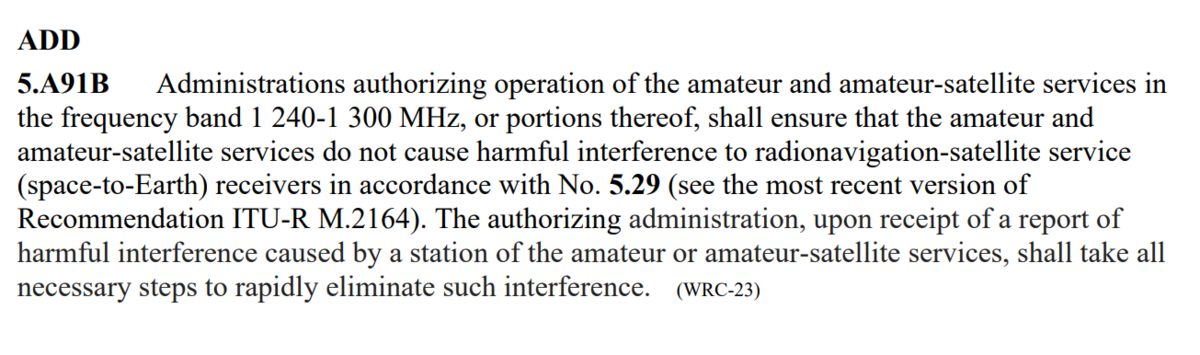
議題9.1-bについては、結局RR(無線通信規則)が改正され、分配表1240-1300MHzについては、脚注が追加されました(21ページ)。RRの規定はITU加盟国を拘束します。
なお、現在付されている番号5.A91Bは暫定的で、あらためて正式な番号がふられます。
ーーーーーーーーーーーーーーーーーーーーーーーーーーーーーーー

ーーーーーーーーーーーーーーーーーーーーーーーーーーーーーーー
以下は追加された第5.A91B号の仮訳です。
過去のWRCの最終文書とこれを翻訳した総務省告示を比較しますと、RRで使用される英単語に対応する日本語の単語や日本語での表現の仕方はほぼ決まっているようです。これに従っているかどうかは確認していません。
なお、WRC-23最終文書が総務省告示として公表される時期は過去の例によれば2024年末ごろだろうと思います。
ーーーーーーーーーーーーーーーーーーーーーーーーーーーーーーー
追加
第5.A91B号 周波数帯域 1 240-1 300 MHz 又はその一部におけるアマチュア業務及びアマチュア衛星業務の運用を許可する主管庁は、第5.29号(勧告ITU-R M.2164の最新版参照)に従って、アマチュア及びアマチュア衛星 業務が無線航行衛星業務(宇宙から地球)の受信機に有害な干渉を生じさせないことを保証しなければならない。権限を有する主菅庁は、アマチュア及びアマチュア衛星業務の局によって生じた有害な干渉の報告を受け取った場合、この干渉を速やかに除去するために必要な全ての措置を講じなければならない。(WRC-23)
ーーーーーーーーーーーーーーーーーーーーーーーーーーーーーーー
RR第5.29号は以下のとおりです。
ーーーーーーーーーーーーーーーーーーーーーーーーーーーーーーー
5.28 3) Stations of a secondary service:
5.29 a) shall not cause harmful interference to stations of primary services to which
frequencies are already assigned or to which frequencies may be assigned at a later date;
ーーーーーーーーーーーーーーーーーーーーーーーーーーーーーーー
仮訳
二次業務の局は、周波数が既に割り当てられている、又は将来割り当てられる可能性のある一次業務の局に対して、有害な干渉を引き起こしてはならない。
ーーーーーーーーーーーーーーーーーーーーーーーーーーーーーーー
アマチュア業務及びアマチュア衛星業務はこの周波数帯では元々二次業務ですから、各国主管庁は「二次業務の局は、周波数が既に割り当てられている、又は将来割り当てられる可能性のある一次業務の局に対して、有害な干渉を引き起こしてはならない。」ことを達成する義務が今回のRR改正とは関係なく元々ありますので、これを達成するための一つの方法が今回のRR改正でRRに盛り込まれたということでしょう。勧告ITU-R M.2164の内容を強制的なルールとして制定するかどうかは各国主管庁の判断だろうと思います。
